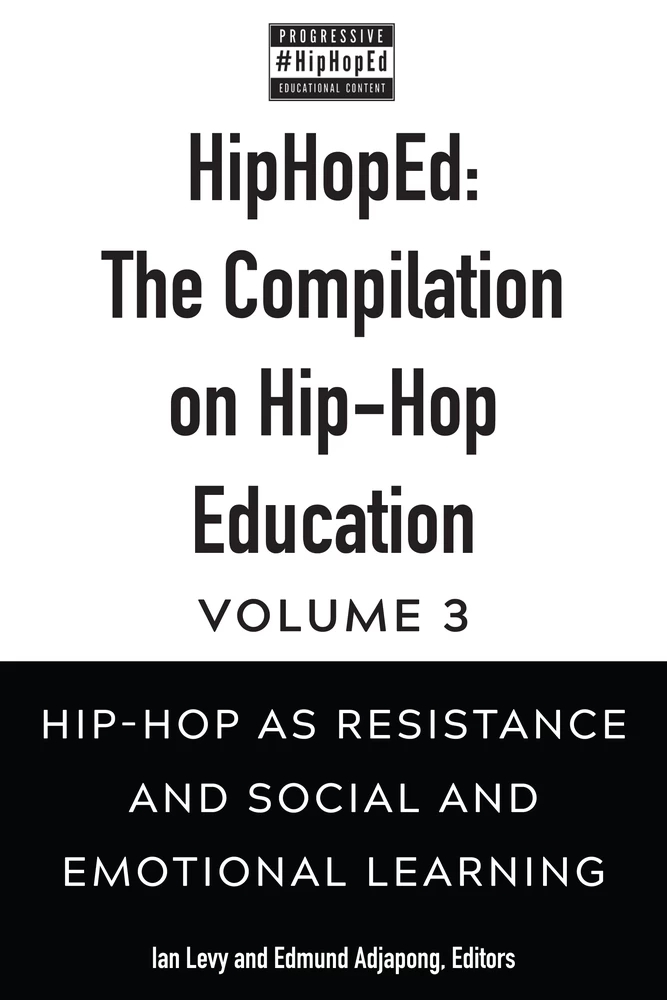
HipHopEd: The Compilation on Hip-Hop Education
Volume 3: Hip-Hop as Resistance and Social and Emotional Learning
Summary
Excerpt
Table Of Contents
- Cover
- Title Page
- Copyright Page
- About the editors
- About the book
- This eBook can be cited
- Table of Contents
- Introduction: Hip-hop as Resistance and Social and Emotional Learning (Ian Levy and Edmund Adjapong)
- Part I: Disrupting Education and Social Norms through Hip-Hop
- Chapter One: From Block Parties to Disrupting Social Norms (Edmund Adjapong)
- Chapter Two: Hip-Hop Intellectualism and the Legitimation of Knowledge in Higher Education (Andrea N. Hunt)
- Chapter Three: A Boogie Down Production: Hip Hop as Disruption and Transformation (Andrew Torres)
- Chapter Four: More than Beats, More than Rhymes, More than Life: The Life of Hip-Hop and Its Developing Identity (Napoleon Wells)
- Chapter Five: The Miseducation of Urban Youth: Knowledge of Self in Therapy as Liberation from Racial Trauma (Mariel Buque)
- Part II: Social and Emotional Learning through Hip Hop Education
- Chapter Six: When 16 Ain’t Enough: Moving beyond Emotional Evocation (Ian Levy)
- Chapter Seven: Pass the Mic: The Therapeutic Potential of Hip Hop Education in Dance and Spoken Word (Gemma Connell)
- Chapter Eight: Building Character through Hip Hop (Janine Brown)
- Chapter Nine: Enter The CIPHER: Building SWAG through Culturally Relevant Pedagogy (Nate Nevado and Kim Davalos)
- Chapter Ten: From BK to the Dirty South and into the Classroom (Qiana Spellman and Ian Levy)
- Contributors

Since its inception, hip-hop has grown into the most consumed genre of music in the United States. This mass success can be seen in history-making accolades such as Kendrick Lamar winning a Pulitzer Prize in music for his album, Damn. The growing acceptance of hip-hop is also evidenced in a rich body of research that documents the effectiveness of hip-hop based education with youth in K–12 educational settings and in community-based programming (Irby & Hall, 2011; Love, 2015; Petchauer, 2015). Hip-hop based education at the post-secondary levels often centers on using lyrics as alternative texts (Gosa & Fields, 2012) and performing content analyses and cultural critiques of the dominant themes and imagery in rap music and videos (Petchauer, 2010). Yet, it extends beyond this and can be used as a lens through which students examine racialized and gendered social structures, sexuality, identity, faith, capitalism, misogyny, cultural appropriation, urban policy, and globalization. Other scholars have also demonstrated how hip-hop based education facilitates cross-racial interactions (Sulè, 2015), increases cultural appreciation (Wessel & Wallaert, 2011), and expands students’ worldviews (Petchauer, 2011).
How do you actually achieve the gains in achievement and social capital that scholars such as Sulè (2015), Wessel and Wallaert (2011), Petchauer (2011) and others describe in postsecondary settings? One way is through critical hip-hop pedagogy (Akom, 2009), which is a community teaching and collaboration model that brings together faculty and community members as co-facilitators in the learning process. I will use the Sociology of Hip-Hop Culture class at the ←9 | 10→University of North Alabama as an example to illustrate this model while addressing the importance of hip-hop intellectualism (Jenkins, 2011) and the legitimation of knowledge (i.e., who is seen as possessing legitimate knowledge in the hip-hop community and in the college classroom). Further, I will explore our own positionality as educators and the importance of building social and cultural capital in both the hip-hop community and in the classroom.
critical hip-hop pedagogy
Before we can fully immerse ourselves in a discussion of critical hip-hop pedagogy, we must begin with Kerber’s (2013) conception of the scholarship of teaching. Kerber (2013) argues that the scholarship of teaching is a transformative social practice that is equally concerned with the value and emancipatory potential of what we do as educators. Central to this process is authenticity. However, academia is often structured in a way that encourages fragmented lives where we are alienated from our labor and are no longer connected to our role as educators (Astin & Astin, 2006; Palmer, 1998). Likewise, students navigate between personal and academic communities trying to reconcile who they are as someone inhabiting these different spaces, which can also lead to fragmented and inauthentic lives.
Authenticity through teaching then means that there is a particular way that we engage with our craft that leads to our own authenticity and, because of this, a way that we engage students that leads to their authenticity. Kerber (2013) asserts that authenticity leads to social justice in higher education that will eventually result in social justice through higher education. We cannot expect students to go out into the world and make a change if they are a part of institutions that do not care about them or their ‘being’ – we have to help students grow in their own authenticity. This is the promise of hip-hop and where critical hip-hop pedagogy fits into the conversation.
Hip-hop based education is influenced by critical and culturally relevant pedagogy (Irby & Hall, 2011; Ladson-Billings, 1995, 2014) that uses hip-hop to validate knowledge of self and community (Love, 2018; Prier & Beachum, 2008). Because of this, there is a certain level of social responsibility when using hip-hop in educational settings. This social responsibility stems from the historical and contemporary patterns of hip-hop as the primary site for marginalized youth to negotiate their identities. Hip-hop has also served as a space for youth to analyze the dominant social institutions and oppressive practices that affect their lives (Gosa & Fields, 2012; Prier & Beachum, 2008).
Critical hip-hop pedagogy as conceptualized by Akom (2009) and elaborated on by Love (2018) is transdisciplinary and addresses social inequalities, experiential knowledge, and social justice. Critical hip-hop pedagogy draws heavily on Freire’s ←10 | 11→(1968/1970) critique of the educational system and his pedagogy of the oppressed that encourages youth to engage in a critical praxis of reflection and action to counter the dominant models of schooling that are designed to reproduce inequality. Critical hip-hop pedagogy is also connected to cultural sustaining pedagogies (Paris & Alim, 2014) and based upon asset pedagogies where language, literacies, and ways of being in marginalized communities are seen as assets rather than deficits. Among this family of pedagogies, the goal is to sustain the notion of different ways of learning by creating linguistic, literate, and cultural pluralism. Another central component of these pedagogies is the need for critical reflexivity to see how as educators we are achieving linguistic, literate, and cultural pluralism and to examine our own biases and ways of being that shape our classrooms. These pedagogies have been vital in reframing the experiences of students of color and moving conversations of equity and access from the margins to the center of educational practices. While the focus is on marginalized students and not concerned with the White gaze (i.e., seeing and experiencing the world through the White viewpoint or lens), Paris and Alim (2014) argue these practices should not be hidden beyond the White gaze. These pedagogies can be used with all students as a way to analyze oppressive practices, cultural and linguistic diversity, and achieve higher consciousness which is needed for all students in an increasingly multicultural and globalized society.
Akom (2009) posits a model of learning through critical hip-hop pedagogy that is participatory, committed to co-learning and co-facilitating, involves local capacity building, and empowers all participants. This means that educators and students are empowered through teaching to be their authentic selves (Kerber, 2013) and are connected to teaching and learning as emancipatory and transformative processes. Using elements of critical hip-hop pedagogy, the next section reflects on teaching a Sociology of Hip-Hop Culture class at a regional institution in the South. The goal is to illustrate how you can create physical and intellectual space within higher education to examine systems of oppression and develop critical problem-solving skills that address some of the most pressing social problems today.
reflections on the sociology of hip-hop culture
The University of North Alabama (UNA) is a predominantly White state regional institution located on the banks of the Tennessee River. Traditional folklore of the Yuchie Tribe, who made their home in the Tennessee River valley, described the waterway as the “the singing river” because of the flowing waters that sounded like a woman singing. It is the birthplace of W.C. Handy and known for the Muscle Shoals sound. Greats such as Aretha Franklin, Etta James, Clarence Carter, ←11 | 12→Wilson Pickett, Ottis Redding, and Percy Sledge all traveled to the Shoals area and were inspired by the singing river to record numerous hits at FAME Studios. The music history in this area is well documented, but hip-hop has been left out of this narrative until more recently. On August 28, 2018, the Alabama Music Hall of Fame unveiled its first hip-hop exhibit curated by Slow Motion Soundz Co-Founder Codie G and featuring Geoffrey “G-Mane” Robinson who are both regular guests to the hip-hop culture class at UNA.
Details
- Pages
- VIII, 132
- Publication Year
- 2021
- ISBN (Softcover)
- 9781433181610
- ISBN (PDF)
- 9781433183416
- ISBN (ePUB)
- 9781433183423
- ISBN (MOBI)
- 9781433183430
- DOI
- 10.3726/b17487
- Language
- English
- Publication date
- 2021 (September)
- Published
- New York, Bern, Berlin, Bruxelles, Oxford, Wien, 2021. VIII, 132 pp.
- Product Safety
- Peter Lang Group AG
