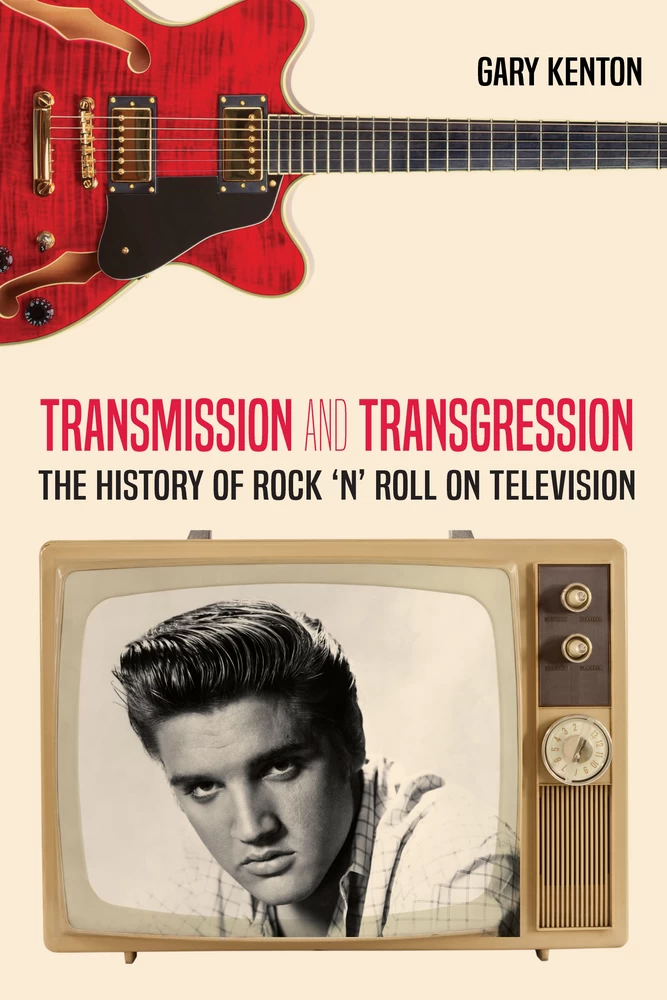
Transmission and Transgression
The History of Rock 'n' Roll on Television
Summary
Transmission and Transgression uses an interdisciplinary approach informed by media ecology, the theoretical framework which recognizes that each communication technology, or medium, creates its own unique environment, independent of content. This analysis allows the author to identify inherent technological and sensory incompatibilities between the medium of television and the cultural practice of rock ‘n’ roll, and to place these tensions within the broader shift of physiological emphasis from the traditional, tribal world dominated by the ear to the modern world which privileges the eye. Even in its remediated, diluted form, rock music has occupied a significant niche on television, and this book is the most comprehensive summary, celebration, and analysis of that history.
Excerpt
Table Of Contents
- Cover
- Title
- Copyright
- About the author
- About the book
- This eBook can be cited
- Table of Contents
- List of Illustrations
- Acknowledgments
- Introduction
- Section I: Historical Context
- Chapter One: The Music and the Audience
- Chapter Two: Rockaphobia
- Chapter Three: The Mediums and the Messages
- Chapter Four: Technologies
- Chapter Five: Reception and Perception
- Section II: Rock Music on Television as a Minority Portrayal
- Chapter Six: The Non-Recognition Era
- Chapter Seven: The Ridicule Era
- Chapter Eight: The Regulation Era, Part 1
- Chapter Nine: The Regulation Era, Part 2
- Chapter Ten: The Regulation Era, Part 3
- Chapter Eleven: The Respect Era, Part 1
- Chapter Twelve: The Respect Era, Part 2
- Chapter Thirteen: The Respect Era, Part 3
- Chapter Fourteen: Conclusion
- Appendix of TV Shows Featuring Rock ‘n’ Roll
- Videography
- Selected Discography
- Index
Gary Kenton
Transmission and Transgression
The History of Rock ‘n’ Roll on Television

PETER LANG
New York • Bern • Berlin
Brussels • Vienna • Oxford • Warsaw
Library of Congress Cataloging-in-Publication Data
Names: Kenton, Gary, author.
Title: Transmission and transgression: the history of rock ‘n’ roll on television / Gary Kenton.
Description: New York: Peter Lang, 2020.
Series: Visual communication vol. 9 | ISSN 2153-277X
Includes bibliographical references and index.
Identifiers: LCCN 2018028628 | ISBN 978-1-4331-5304-4 (hardback: alk. paper)
ISBN 978-1-4331-5309-9 (paperback: alk. paper) | ISBN 978-1-4331-5310-5 (ebook pdf)
ISBN 978-1-4331-5311-2 (epub) | ISBN 978-1-4331-5312-9 (mobi)
Subjects: LCSH: Rock music on television.
Classification: LCC PN1992.8.M87 K46 | DDC 791.45/6578—dc23
LC record available at https://lccn.loc.gov/2018028628
DOI 10.3726/b14573
Bibliographic information published by Die Deutsche Nationalbibliothek. Die Deutsche Nationalbibliothek lists this publication in the “Deutsche Nationalbibliografie”; detailed bibliographic data are available on the Internet at http://dnb.d-nb.de/.
© 2020 Peter Lang Publishing, Inc., New York
29 Broadway, 18th floor, New York, NY 10006
All rights reserved.
Reprint or reproduction, even partially, in all forms such as microfilm, xerography, microfiche, microcard, and offset strictly prohibited.
About the book
When MTV (Music Television channel) was established in 1981, an executive claimed that they had “integrated the most powerful forces in our two decades, TV and rock ‘n’ roll.” In fact, this problematic relationship began in the mid-1950s, when the advent of rock ‘n’ roll represented a musical and cultural revolution. The backlash against the music and the youth culture from which it emanated, described here as “rockaphobia,” was reflected in a process of adulteration, racism, and co-optation by television programmers, spearheaded by American Bandstand. This interplay between rock ‘n’ roll and television played a significant role in alienating baby boomers from the mainstream, motivating them to create their own countercultural identity. This social migration helped to delineate the boundaries that would be identified in the 1960s as the generation gap.
Transmission and Transgression uses an interdisciplinary approach informed by media ecology, the theoretical framework which recognizes that each communication technology, or medium, creates its own unique environment, independent of content. This analysis allows the author to identify inherent technological and sensory incompatibilities between the medium of television and the cultural practice of rock ‘n’ roll, and to place these tensions within the broader shift of physiological emphasis from the traditional, tribal world dominated by the ear to the modern world which privileges the eye. Even in its remediated, diluted form, rock music has occupied a significant niche on television, and this book is the most comprehensive summary, celebration, and analysis of that history.
This eBook can be cited
This edition of the eBook can be cited. To enable this we have marked the start and end of a page. In cases where a word straddles a page break, the marker is placed inside the word at exactly the same position as in the physical book. This means that occasionally a word might be bifurcated by this marker.
chapter
Table of Contents
Chapter One: The Music and the Audience
Chapter Three: The Mediums and the Messages
Chapter Five: Reception and Perception
Section II: Rock Music on Television as a Minority Portrayal
Chapter Six: The Non-Recognition Era
Chapter Seven: The Ridicule Era
Chapter Eight: The Regulation Era, Part 1
Chapter Nine: The Regulation Era, Part 2
Chapter Ten: The Regulation Era, Part 3
Chapter Eleven: The Respect Era, Part 1
Chapter Twelve: The Respect Era, Part 2←vii | viii→
Chapter Thirteen: The Respect Era, Part 3
Appendix of TV Shows Featuring Rock ‘n’ Roll
Index←viii | ix→
chapter
Figure I.1: Neil Postman, one of the fathers of Media Ecology.
Figure 1.1: Marlon Brando, as an endearing delinquent in the 1953 film The Wild One.
Figure 1.2: Bill Haley and His Comets still rocking around the clock in 1960.
Figure 2.1: The Treniers in Don’t Knock the Rock. They were frequently on TV in the pre-rock era, but were not perceived as a threat.
Figure 2.2: Don Cornelius with Curtis Mayfield in the early Chicago days on Soul Train. Cornelius made Black Americans visible on television.
Figure 3.1: The 1950s American family gets programmed.
Figure 3.2: “Professor” Chuck Berry sings “School Days” on American Bandstand.
Figure 4.1: The music goes round and round and comes out here: The Regency, “the world’s first pocket radio.”
Figure 4.2: Les Paul trades riffs with his wife Mary Ford on The Colgate Comedy Hour.
Figure 5.1: On TV, the eye wins the sensory battle between sight and sound.
Figure 5.2: Marshall McLuhan tries to explain Media Ecology to Tom Snyder on The Tomorrow Show.←ix | x→
Figure 6.1: Carl Perkins and Perry Como—two nice guys on The Perry Como Show.
Figure 6.2: Johnny Otis, the great impresario of Los Angeles rhythm ‘n’ blues.
Figure 7.1: Elvis Presley on The Steve Allen Show. Putting Elvis in a tuxedo wasn’t enough; he had to sing to a basset hound.
Details
- Pages
- XII, 344
- Publication Year
- 2020
- ISBN (Hardcover)
- 9781433153044
- ISBN (PDF)
- 9781433153105
- ISBN (ePUB)
- 9781433153112
- ISBN (MOBI)
- 9781433153129
- ISBN (Softcover)
- 9781433153099
- DOI
- 10.3726/b14573
- Language
- English
- Publication date
- 2020 (March)
- Published
- New York, Bern, Berlin, Bruxelles, Oxford, Wien, 2020. XII, 344 pp., 30 b/w ill., 1 table
- Product Safety
- Peter Lang Group AG
