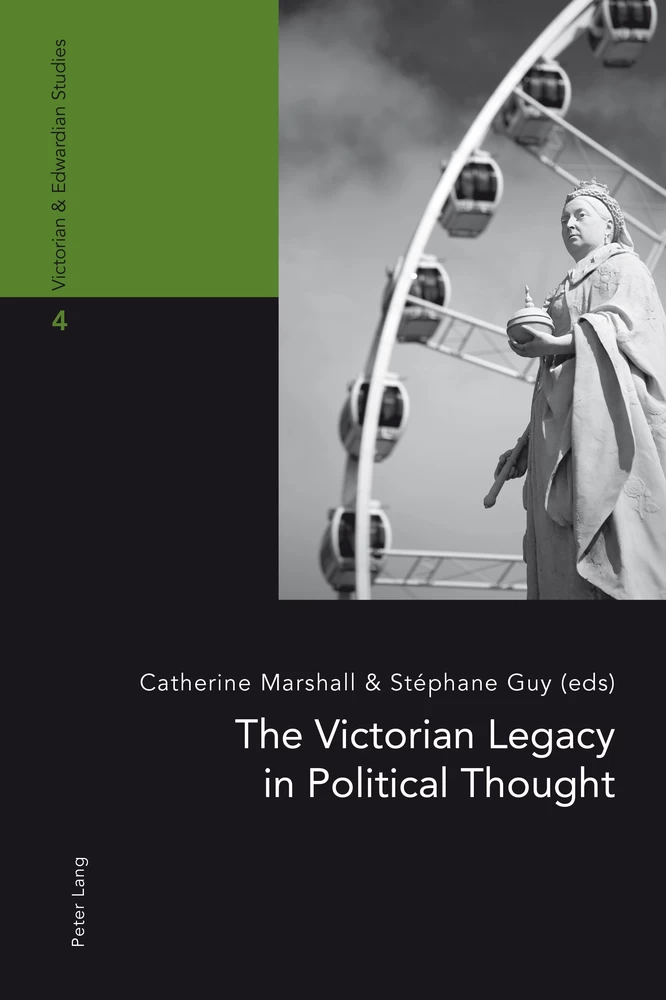
The Victorian Legacy in Political Thought
Summary
Have reformist, socialist, liberal or utilitarian ideas avoided the dogmatism of twentieth century politics or paved the way to other forms of ideology? To what extent has the organization or gradual obliteration of the State been influenced by evolutionary theories, the quest for effective government and expertise or, more generally, refusal of the past? What was the impact of Victorian thinkers and ideas on the mutation of contemporary political ideas? Have we reached a post-Victorian period or are we still using a Victorian rhetoric as well as Victorian theories? Have we not, also, reached a stage in which retrieving some of those ideas might help to solve some of our contemporary political problems? The essays presented in this book all attempt to answer some of these questions and try to show how nineteenth century thought and culture have shaped British modern political debate and, for some, still continue to do so. It will prove useful to academics and the general public interested in contemporary politics as well as the history of ideas and political philosophy.
Excerpt
Table Of Contents
- Cover
- Title
- Copyright
- About the Editors
- About the Book
- This eBook can be cited
- Contents
- Acknowledgements
- Introduction: Catherine Marshall & Stéphane Guy
- 1. Part I (Mis)construing the Victorians
- 2. Part II – Succeeding (to) the Victorians
- 3. Part III – (Mis)using the Victorians
- 3.1. The Victorian roots of the contemporary political paradigm
- 3.2. The Victorian age vs. the post-war consensus
- 3.3. A multiform legacy: the test of periodization
- Part I: (Mis)construing the Victorians
- Bentham in the Twentieth Century: A Survey of the Times Literary Supplement: Emmanuelle de Champs
- 1. General Overview
- 2. Victorian Values and the Industrial Revolution
- 3. The Genealogy of British Liberalism
- 4. Bentham and the Philistines
- 5. The Bentham Committee and the New Bentham
- 6. An Enduring Legacy?
- Bibliography
- Primary sources
- Secondary sources
- Thomas Carlyle’s Legacy, Past and Present: Catherine Heyrendt-Sherman
- 1. Carlyle’s Legacy through Others
- 2. Periodical Rediscovery and Controversy over Carlyle’s Legacy
- 3. Carlyle’s Legacy Today, Actual and Prospective
- 3.1. Denunciation of social inequalities
- 3.2. The right to work and receive fair wages
- 3.3. “The terror of ‘Not succeeding’; of not making money”
- 3.4. Carlyle’s vision of progress: a peaceful, green and humane world
- Bibliography
- Books
- Articles
- Negative Liberty and Mill’s Libertarian Reputation: A Reconsideration: Gregory Claeys
- Introduction: Mill, Autonomy and Negative Liberty
- 1. Josiah Warren and the Sovereignty of the Individual
- 2. Mill and Liberty
- 3. Mill’s Later Victorian Reputation
- Bibliography
- Whig Thought: Historiographical Perspectives: Aude Attuel-Hallade
- 1. Herbert Butterfield and the National Whig History: An Ambiguous Legacy in the Historiographical and Political British Tradition
- 2. The “Herbert Butterfield Problem”: the Paradoxes in Butterfield’s Historical Thought
- 2.1. The Intellectual Objectives of The Whig Interpretation of History and of The Englishman and his History
- 2.2. Political action and Providentialism in Butterfield
- 3. A Historical Myth to Serve Politics
- 3.1. Butterfield and the French Revolution: Rupture and the “Myth of Continuity”
- 3.2. Butterfield’s “Conservative Whiggism”: a Burkean or a “Macaulyan” Heritage?
- 4. English Exceptionalism
- 4.1. “Little England”
- 4.2. The Persistence of the Whig Paradigm in Contemporary Political Narrative and Historiography
- Bibliography
- Primary Sources
- Secondary sources
- Part II: Succeeding (to) the Victorians
- The Legacy of British Idealism in Political Thought and Today’s Problems of State Building: Michael Henkel
- Introduction: The Fate of British Idealism from the Time of Queen Victoria up to the Present Day
- 1. Political Thinking in British Idealism: Bernard Bosanquet
- 2. Bosanquet’s Political Thinking as a Living Legacy: on the Problems of State Building
- 3. Fukuyama’s Theory of State Building
- 3.1. Aspects of Stateness
- 3.2. Effective Organization and Social Capital
- 4. Some Aspects of Bernard Bosanquet’s Theory of the State
- 4.1. Bourgeois Society
- 4.2. From bourgeois Society to the Political State: Good life, Liberty & General Will
- 5. Citizenship, State Building, and the Western Civilization of Freedom
- Bibliography
- Welfarist and Moral Justifications of the Strong State: Reconciling Hobhouse’s and Bosanquet’s Perspectives on the Role of the State: Maria Dimova-Cookson
- 1. Hobhouse on Liberty and the Welfare State
- 2. Hobhouse’s Critique of Bosanquet’s Idealism
- 3. Bosanquet’s Moral Defence of the State
- Bibliography
- A Forgotten Hero of British Social Democracy? The Historical Significance of Edward Caird: Colin Tyler
- 1. Frank Field’s Saints and Heroes
- 2. Balliol, Beveridge and Caird
- Bibliography
- Archives consulted
- Idealism and Religion: The Legacy of Victorian Debates: Andrew Vincent
- 1. The British Idealist Movement
- 2. Robert Elsemere and Religious Anxiety
- 3. Three Pressures on Late Victorian Transcendent Religion
- 4. Philosophical Theology
- 5. Kantianism and Immanentism
- 6. A Modern Corollary: an Awareness of What is Missing
- 7. Kantianism Redivivus
- 8. A Rediscovered Kulturkampf
- Bibliography
- Mark Bevir and Victorian Idealism: Jean-Paul Rosaye
- Bibliography
- Victorian Idealism – Then and Now: Mark Bevir
- Bibliography
- Part III: (Mis)using the Victorians
- Margaret Thatcher’s “Victorian values”: A Reappraisal: Christian Auer
- Bibliography
- Margaret Thatcher and Conservative Feminism – A Rehabilitation of Victorian Values: Françoise Orazi
- 1. Thatcher and “Feminist Policies”
- 2. Conservative Feminism
- Bibliography
- The Victorian Prison Revisited? The Antecedents of British Penal Policy, 1993–2010*: Neil Davie
- 1. Hard Labour, Hard Fare and a Hard Bed?
- 2. The Un-Victorian Prison
- Bibliography
- New Labour’s Discourse on Social Cohesion and the First Fabians’ Paradoxical Legacy: the Case of Anti-Social Behaviour: Marie Terrier
- 1. Anti-Social Behaviour: Meaning and Implications of a New Concept
- 1.1. Uneasy Definition of a Successful Concept
- 1.2. Justification and Debate
- 2. Continuities and Differences with “Anti-Social” for the First Fabians
- 2.1. Anti-Social, Selfish and Idle
- 2.2. Nature and Origin of Anti-Social Behaviour
- 2.3. The Community and the State
- Bibliography
- The Lib-Lab Roots of New Labour: Yann Béliard
- 1. New Labour and Lib-Labism: A Few Signposts
- 2. Distrust of the poor
- 3. The Cult of Community
- 4. Aversion to Social Conflicts
- Bibliography
- Primary sources
- Secondary sources
- Social Policy Serving the Economy: A Victorian Legacy: Jean-Paul Révauger
- 1. The Victorian model as a permanent feature of British social policy
- 2. The Beveridge Moment: norm or accident?
- 3. The Victorian legacy in contemporary social policy
- 4. The harder the fall.
- Bibliography
- The “Problem” of the Poor: Welfare Reform in Contemporary Britain and the Legacy of Tocqueville’s Mémoire sur le paupérisme: Christine Dunn-Henderson
- 1. The Mémoire
- 2. The Modern System… and Contemporary Reform
- Bibliography
- Conclusion: Beyond the Victorian Legacy: Noel O’Sullivan
- 1. Beyond the Victorian Legacy
- 1.1. The liberal concept of the political as an order of rights based on a rational ideal of justice
- 1.2. The discourse theory of the political
- 1.3. The agonal concept of the political
- 1.4. The postmodern concept of the political
- 2. The three aspects of the concept of the political
- 2.1. The standpoint from which the political is studied
- 2.2. The content or focus of the study of the political
- 2.3. The need to relocate political concerns within the broader framework of a theory of practical wisdom or prudence
- Bibliography
- Notes on Contributors
The editors offer grateful acknowledgement to Professors Franck Lessay (University of the Sorbonne Nouvelle – Paris III) and Noel O’Sullivan (University of Hull) for their constant support and for having provided the inspiration for this collection of essays. From both sides of the Channel, they have guided us and helped our reflection on the subject throughout the years. May they receive our warmest thanks.
Our University – Cergy-Pontoise University – through our research centre – the CICC –, the University Trust, and our Faculty, have also greatly eased our work through the funding given for the conference which inspired this work and for the great contribution given to the publication of this book.
At our research centre, Arkiya Touadi provided invaluable support by guiding us through the funding system, helping to make the project come through at every single stage and by being such a thorough and devoted colleague.
We also benefited from the invaluable help of a team of students in the Master’s degree in Publishing and Communication studies in our University – Gladys Caré, Élodie Fiette, Iris Munsch and Tania Pruvost – who took on our project with great care. Our special thanks go to Iris Munsch who finalised the work, a year after it was started, and did so with great patience, rigour and consideration. We extend these warmest thanks to Professor Joanna Nowicki and Dr. Luciana Radut-Gaghi, who agreed to take on the project with their students and who were both generous with their time. We are also most grateful to Sylvie Kleinman for the faithful translations of three of the contributions.
Last but not least, we want to thank the contributors of this book for their patience and for their most fruitful collaboration. Through their work, we have been able to understand the Victorian legacy better and it is to them that we dedicate this work.
Catherine Marshall & Stéphane Guy
Cergy-Pontoise University,
October 2013.
← 9 | 10 → ← 10 | 11 →
The idea for this collection of essays became a reality when, as two Victorian scholars in France, we felt that the political ideas which came into existence in the Victorian period – most especially in the second half of the 19th century – were either misunderstood, misused or ignored in British contemporary political thought. To our minds, most of the political and social ideas of the end of the 20th century and beginning of the 21st century in Britain still rely heavily on the ideas framed in the 19th century and should be acknowledged as such.
Certain contemporary political terms are used along with certain values, with a misunderstanding as to what was originally meant at the time. The use of a Victorian rhetoric hides the fact that there is often no recognition of the importance of Victorian sources and how they could be of use to contemporary political thinkers, if used properly.
Details
- Pages
- 376
- Publication Year
- 2014
- ISBN (Softcover)
- 9783034314954
- ISBN (PDF)
- 9783035106817
- ISBN (MOBI)
- 9783035196603
- ISBN (ePUB)
- 9783035196610
- DOI
- 10.3726/978-3-0351-0681-7
- Language
- English
- Publication date
- 2014 (May)
- Keywords
- polity pragmatism democratic compromise ideology
- Published
- Bern, Berlin, Bruxelles, Frankfurt am Main, New York, Oxford, Wien, 2014. 376 pp.
- Product Safety
- Peter Lang Group AG
