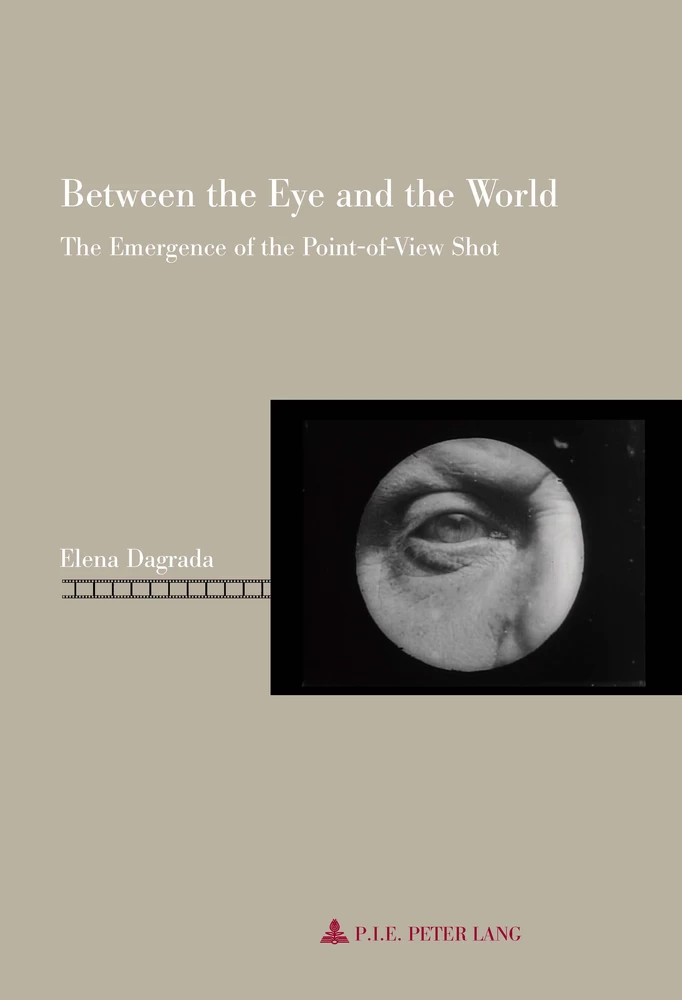
Between the Eye and the World
The Emergence of the Point-of-View Shot
Summary
Excerpt
Table Of Contents
- Cover
- Title
- Copyright
- About the author
- About the book
- This eBook can be cited
- Contents
- Introduction
- Chapter 1: The Archaeology of a Filmic Form
- 1.1. Early Cinema, Early Spectator
- 1.1.1. The World As Spectacle
- 1.1.2. Transformations of the Visible
- 1.2. The Place of the Look
- Chapter 2: Frontiers of the Visible
- 2.1. The Eye and the World, or the Faculty of Sight
- 2.2. Bigger, Not Closer: Grandma’s Reading Glass
- 2.3. A History of Filmic Forms and the Historiography of the Cinema
- Chapter 3: The Circle and the Keyhole
- 3.1. Clues to a Paradigm
- 3.1.1. Autonomy
- 3.1.2. The Line of Vision
- 3.1.3. Movement
- 3.1.4. The Matte
- 3.1.5. Alternation
- 3.1.6. Gesture
- 3.1.7. The Punitive Ending
- 3.2. This Side of the Circle, the Other Side of the Keyhole
- Chapter 4: Towards Linearisation
- 4.1. The Look and the Story
- 4.2. Parataxis and Hypotaxis
- 4.2.1. Isomorphic Combinations
- 4.2.2. Polymorphic Combinations
- 4.3. Linearisation, Centring and the Match Cut
- 4.3.1. The Match Cut and the Look
- 4.3.2. From the Enlargement to the Insert
- 4.3.3. Alternation and Linkage
- 4.3.4. The Partial Line of Vision
- 4.3.5. Reading and Writing
- 4.3.6. The Diegetic Spectator
- 4.4. With the Naked Eye
- Chapter 5: The Inner Gaze
- 5.1. Forms of Vision
- 5.1.1. The Magic of the Eye Before the Cinema
- 5.1.2. The Circle and the Focus
- 5.1.3. Forms of the Dream
- 5.1.4. Attractions and Apparitions
- 5.1.5. The Memory Eye
- 5.2. From Magic to Introspection
- Bibliographic References
- Index of Names and Film Titles
- Series index
The Archaeology of a Filmic Form
1.1. Early Cinema, Early Spectator
Among the flickering views that inhabit early cinema screens, one image recurs so often that it becomes interesting in its own right. This is the matte or mask, usually circular or keyhole-shaped, through which astronomers and scientists, barbers and porters, maids and pageboys, students and urchins are to be found peering. They may be ordinary people or fantasy characters, adults or children, proletarians or bourgeois, yet all of them are inevitably voyeurs (or voyeuses) intent on exercising their “faculty of sight”.1
On a strictly iconographic level, this matte is identical to the one representing the telescope through which James Bond observes his enemy’s moves while playing cards in Goldfinger (Guy Hamilton, 1964), or to the snooperscope through which the killer in The Silence of the Lambs (Jonathan Demme, 1991) secretly observes the agent who is trying to hunt him down. – Or – to quote another, more recent example – it is identical to the peephole through which, in Das Leben der Anderen (The Lives of Others, Florian Henckel von Donnersmarck, 2006), a nextdoor neighbour sees the Stasi Captain Wiesler breaking into Georg Dreyman’s apartment. In other words, it is identical to the matte still used today in contemporary cinema to signify the presence of a character looking through the lens of a telescope (or binoculars, or any other optical viewer), in order to create what is commonly called the point-of-view shot. An ambiguous name2 for ← 15 | 16 → a fascinating filmic form, showing on the screen what a character sees, and thus making that character the subject of a gaze.
Film scholars have often played particular attention to this filmic form, because of its multiple implications which can be applied to the spheres of film style, enunciation, cinematic language, narrative perspective, subjectivity and distribution of knowledge; because of its numerous variations, such as eyeline match, shot/reverse-shot, mental image and “memory image”;3 finally, because of its wide popularity, which turned it into a much used and abused technique,4 appearing today not only in fiction films, but also in non-fiction films, docudramas, documentaries, mockumentaries, advertising, cartoons, comics, and across the whole range of television genres, as well as video game genres. Once in a while, someone even decides to rechristen it,5 although spectators understand it without needing to know it has a name, or what this name might be.
Nowadays, the matte as employed in early cinema is rarely used,6 since the point-of-view pattern is indicated in an increasingly essential and elliptical form. Today’s spectator needs very few clues to “recognise” it: a simple country road filmed with a hand-held camera moving forward, accompanied by the noise of hurried footsteps, the sound of heavy breathing or of a heart beating, is enough for the action to be interpreted ← 16 | 17 → as the point-of-view shot of a person fleeing from someone or something, even if the spectator has no idea who it is and has never seen the person’s face. It often happens in Dario Argento’s or Brian De Palma’s films, for example, where an abrupt movement, accompanied by the amplified sound of breathing, is enough to reveal the presence of someone looking: usually a character whom the spectator has not seen up to that point. And a circular matte, such as the one described above, may still be sufficient to suggest the presence of a diegetic look7 from behind an optical viewer. To create suspense. Tension. Expectation. Anticipation. Apprehension.
Consequently, wondering how and where today’s spectator acquires the skills necessary to interpret certain clues and signals – such as the forward of a hand-held camera or a steadicam, or heavy breathing, or a circular matte – as signifying the presence of an unseen character looking (and thus what this character sees) might appear to be a rather idle occupation. Asking where the point-of-view shot comes from could seem a rhetorical question with a self-evident answer: it proceeds from previous occurrences of the matte, described above, from behind which James Bond scrutinises his antagonist’s moves. That is, it proceeds from those numerous early films which, for the very first time, show what a character sees by surrounding the image with a matte, identical in form to that used so much later in Goldfinger. It is precisely what happens in the best-known of these early films, Grandma’s Reading Glass (G.A. Smith, 1900), where a child seizes a magnifying glass to observe some objects (a newspaper page, a canary in its cage, a watch…), which appear magnified on screen and framed by a circular matte.
Of course, there are many differences between early films such as Grandma’s Reading Glass and subsequent point-of-view structure. In films of the following decades the matte itself may be absent. Early films, on the other hand, lack sound and much else. On a substantive level, moreover, the gap is even wider, because James Bond’s point-of-view shot informs spectators and influences their participation in the event the British secret agent is involved in. In early films, though, there is often no event at all in which the spectator is invited to participate; there is merely someone looking at something.
Nevertheless, these early films – where a variety of different characters observe a variety of different objects through something – still present views which are mediated through the evidence of a gaze. ← 17 | 18 →
Yet, to think that these films really provide the answer to the question formulated above would be naïve. Grandma’s Reading Glass, which is still the earliest-known film to represent a character’s gaze, is surely not some miraculous epiphany, the very first appearance of the point-of-view structure. Not only because of the important differences previously mentioned, but also because, even if it were indeed the first film in cinema history to feature the point-of-view structure, referring to it as the “first case”, as an epiphany, even as an invention, would not provide a real answer. Determining a filmic form’s first occurrences is not enough to define its origins; it is also important to trace the driving forces which brought it about. It is crucial to grasp its cultural dimension, in order to define its role in that transformation process of the visible without which it might not have materialised. Nothing comes from nothing: if we wish to trace the genesis of the point-of-view structure we must also search for the reasons that made possible its emergence in the first place – that is to say, the reasons which favoured the emergence of this form, rather than some other.
From this perspective, it is still essential to try to identify these “first cases”, for not only do they enable a careful examination of its earliest manifestations; they also exhibit – in their iconographic composition as well as in the themes dealt with – the elements necessary to bring to light the answer we are seeking.
Grandma’s Reading Glass, like any other early film where we find this mode of representation of the gaze, belongs to the era of early cinema, which is far distant from what cinema became afterwards. If dealt with on the basis of our present expectations, it would inevitably seem impenetrable, like a foreign language which we do not understand. In fact, the era of early cinema is not defined solely by the films produced in the first fifteen or twenty years of cinema history, but is also inextricably bound up with the spheres of science, spectacle and iconography, within which these films circulated.8 Parallel to the incubation, gestation and subsequent stabilisation of film entertainment, the age of early cinema was subject to countless scientific, technological and cultural developments, which modified the way in which the whole world was being experienced, and which thus influenced the mechanisms of artistic and imaginative creation.9 Furthermore, the era of early cinema is the one in which cinema itself emerges as a product halfway between an optical, scientific ← 18 | 19 → phenomenon and a sideshow attraction, where old and new forms of popular entertainment meet. In a way, early cinema itself represents a sort of intersection between past and future forms of spectacle, intertwined with the development of optical techniques and scientific advances.
While this film practice does indeed appear for the first time at this intersection, it does so bearing meanings that are different to the ones understood subsequently, and assumes different modes and roles from those it will have in the years to follow.
For all these reasons, we must approach the origins of the point-of-view structure in an archaeological fashion – in the sense suggested by Michel Foucault.10 We must map out the scientific and entertainment devices that paved the way for the advent of cinema and merged into it, and excavate its gaps and empty spaces with the meticulousness of an “archaeologist of knowledge”, bringing together the history of culture and the history of filmic forms.
Early cinema, in fact, is also a lost cinema; a cinema which has been destroyed and altered, which has been made unknown and inaccessible. In order to fill in its gaps and empty spaces, we must therefore try to reconstruct the discussions which would have taken place at the time that the form we are dealing with makes its earliest appearances. As archaeologists – and philologists – of knowledge, we must strive to trace the history of this form, connecting it with what can be reconstructed of the context in which it was born. That is, we must broaden the notion of source to that network of varied material that Gérard Genette11 named “paratext” – sales catalogues, advertisements, paper and iconographical documents – and interweave its analysis with the examination of what remains of the films themselves. Sometimes, indeed, this network of paratextual materials constitutes the only proof that a certain film existed. Catalogue descriptions may provide the only clues, if not how these films were viewed, at least how they should have been viewed and might have been received; they can provide suggestions about the possible reception that was expected from the audience, or about the way a lecturer – whenever present – would accompany the screening by commenting on it, and thus directing the audience’s understanding in the desired direction.
In other words, in order to learn how to understand correctly those early films where the representation of the gaze makes its first appearances, to grasp their complexity in depth, to fully comprehend their mechanisms and multiple cultural references, we must make the effort to set aside our contemporary competences, adopting instead those possessed by ← 19 | 20 → early film spectators. We must reject our expectations in order to embrace those of the spectators to whom early cinema is addressed. We must try to “become” those early spectators who would have recognised, in early cinema, their own skills at decoding iconography and spectacle, their own psychological and cultural understanding, as well as the symbolic references to their own horizon of expectations.12
But if this is the case, in order to find an adequate answer to our enquiry, we must first change the question from “Where does the point-of-view shot come from?” to “Where does the spectator addressed by this form of representation of the gaze come from?” We must first conduct an enquiry into the early film spectator’s perceptual experiences. That is, we must first ask from which images these images are derived, and how the early film spectator would have seen them.
Details
- Pages
- 246
- Publication Year
- 2014
- ISBN (PDF)
- 9783035265262
- ISBN (MOBI)
- 9783035299977
- ISBN (ePUB)
- 9783035299984
- ISBN (Softcover)
- 9789052010359
- DOI
- 10.3726/978-3-0352-6526-2
- Language
- English
- Publication date
- 2015 (May)
- Keywords
- cinema historiography of film interposition in view Contemporary debates in the digital media landscape filmic form Point-of-view shot Character's subjective viewpoint
- Published
- Bruxelles, Bern, Berlin, Frankfurt am Main, New York, Oxford, Wien, 2015. 246 pp., num. ill.
- Product Safety
- Peter Lang Group AG
